
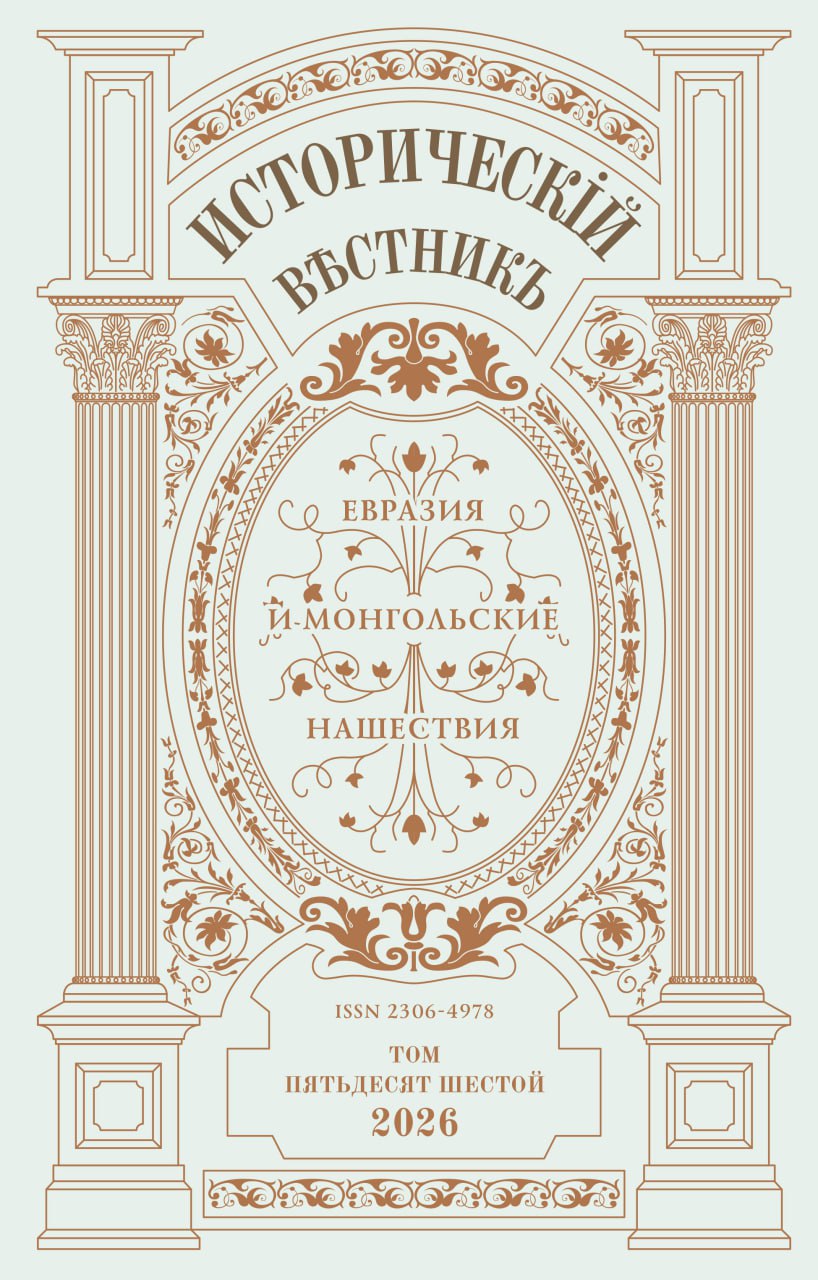
The Mongolian Invasion of Eurasia
VOL. 56 [203]
Editorial Note
This is the third issue (following those published in 2014 and 2018) devoted to the conquests of the Mongol Empire and their consequences for the countries of Europe and Asia. The current volume explores a wide range of topics.
Yuliy I. Drobyshev examines the history of the study of Mongol imperial ideology of the 13th–14th centuries in Russian scholarship.
The article Organization of the Mongol Taxation Policy in the Conquered Lands: Problems and Solutions (co-authored by Marat S. Gatin, Lenar F. Abzalov, Ilias A. Mustakimov, Roman Yu. Pochekaev) is based on the study of legal documents and narrative sources containing information about the features of the tax system in the Mongol Empire and its uluses in China, the Ulus of Jochi (the Golden Horde), Mongol Iran, and the Chagatai Ulus in the first decades after the establishment of power there by the descendants of Chinggis Khan. The article introduces into scholarly circulation for the first time a Russian translation of a medieval document—a yarlyk (charter, decree) appointing a tax overseer—from the treatise Dastur al-Katib by the 14th-century Persian official Muhammad ibn Hindushah Nakhjavani.
Elisey S. Kuznetsov and Yuriy.V. Seleznev examine the mention of the toponym “Voronezh” in the chronicle accounts of Batu’s invasion of Rus’. Based on an analysis of the chronicle vocabulary, the authors conclude that the reference is not to a vaguely defined locality (countryside) or a river, but to a city.
Mikhail K. Yurasov analyzes the objectives of Batu’s campaign in Hungary and their implementation. It is convincingly shown how these goals changed from the intention to make the Middle Danube region the political center of the Ulus of Jochi to purely destructive actions.
Vladimir N. Rudakov analyzes source information on the death of Grand Prince Yaroslav Vsevolodovich in the camp of the Great Khan Güyük in Mongolia (1246). The study traces how the initial interpretation in later sources gradually acquired additional details of literary origin.
This issue also includes the section “Source,” which is not connected with the main topic. In it, we continue publishing excerpts from the Autobiographical Notes of the prominent Moscow entrepreneur and political figure of the early 20th century, N. P. Vishnyakov. This publication, like all the previous ones, has been prepared by Vladimir V. Hutarev-Garnishevsky.
The two reviews concern new works on the history of the Soviet period. Maksim M. Stelmak presents an analytical review of the popular-science publication by A. V. Minzhurenko, Essays on the Political History of Omsk during the Civil War. Arushan A. Vartumian reviews the monograph by V. A. Nevezhin, Joseph Stalin’s Activities in the Field of Foreign Policy and Diplomacy on the Eve of the Great Patriotic War. Both reviews are distinguished by a rigorous scholarly approach, objectivity, and depth of historical analysis.
The editorial board of the journal continues its work on preparing future issues of The Historical Reporter, which, hopefully, will not disappoint our readers.
A. E. Titkov
Editor-in-Chief of The Historical Reporter
Contents
- Yuliy I. Drobyshev The Mongolian Imperial Idea in the Writings of Russian Historians Before 1991
- Marat S. Gatin, Lenar F. Abzalov, Ilias A. Mustakimov, Roman Yu. Pochekaev Organization of the Mongol Taxation Policy in the Conquered Lands: Problems and Solutions
- Elisey S. Kuznetsov, Yuriy V. Seleznev The Mention of Voronezh in the Accounts of Batu Khan’s Invasion
- Mikhail K. Yurasov Changing Objectives of Batu’s Campaign in Hungary and the Reasons for the Mongol Withdrawal in 1242
- Vladimir N. Rudakov Information from the «History of the Mongols» about the Death of Grand Duke Yaroslav Vsevolodovich in the Context of Reports from Russian Sources in the Second Half of the 13th — 15th centuries
Scientific life
- Maksim M. Stelmak To the publication by A.V. Minzhurenko of essays on the political history of Omsk during the Civil War
- Arushan A. Vartumian The Foreign Policy and Diplomatic Activities of J.V. Stalin on the Eve of the Great Patriotic War. Review of the monograph by V.A. Nevezhin «The Return of a Great Power. Stalin's Foreign Policy and Diplomacy (May 1939 – April 1941)». Moscow: Veche, 2025. 464 p.: ill. 236
Sources
- Vladimir V. Hutarev-Garnishevsky Savva Morozov and Nikolay Naydionov: the bigwigs of the old-Moscow business in Nikolay Vishnyakov’s memoirs, 1905